


Two commercials, back to back, same ad break. One promises "debt relief" and a fresh start. The other, from your own bank, pitches "debt consolidation" and a single lower payment. Most people watching assume they're choosing between two versions of the same product. Strip away the marketing, though, and debt relief vs debt consolidation comes down to two entirely different transactions: paying back less than you owe, or paying back everything you owe on friendlier terms. Confusing the two costs people thousands of dollars, years of credit repair, and in some cases a lawsuit they never saw coming.
What "Debt Relief" Actually Means When an Ad Says It
In almost every case where you hear "debt relief" on daytime TV or drive-time radio, the company on the other end of that phone number is selling debt settlement. The Consumer Financial Protection Bureau defines it plainly: a debt settlement program has you stop paying your creditors directly and instead deposit money into a dedicated account each month. Once enough funds build up, the company (or you) negotiates with each creditor to accept a lump sum that's smaller than the full balance owed.
That single word, stop, is doing most of the damage here. You aren't paying anyone while the settlement account fills up. Late fees and interest keep compounding on the original balances. Your credit reports show missed payments in real time. The CFPB is direct about the risk this creates: while you're saving up to settle, a creditor can simply file a debt-collection lawsuit against you, and nothing about being enrolled in a settlement program stops that from happening. The ad calls this relief. A credit analyst would call it a bet that enough creditors settle before one of them sues.
What "Debt Consolidation" Actually Means
Consolidation is a different transaction entirely. You take out a new loan, and that loan pays off your existing balances. From that point forward, you owe one lender instead of several, on one schedule, at one interest rate. Nothing about the amount you owe changes. If you had $18,000 spread across four credit cards, you now have $18,000 owed to one lender. Every dollar of principal is still yours to repay; consolidation restructures the payment schedule, and the amount owed stays the same.
This is the part that gets lost between the two ads. A bank offering consolidation is selling one payment and, if you qualify, a lower rate than your cards were charging. Erasing principal is not on the menu. That's a real benefit for the right borrower, but it isn't the same benefit a settlement ad is implying when it talks about getting "out of debt" for less than you owe.
Debt Settlement Credit Score Impact: How Big, and How Long
The two paths hit your credit report in completely different ways, and the gap is larger than most people expect.
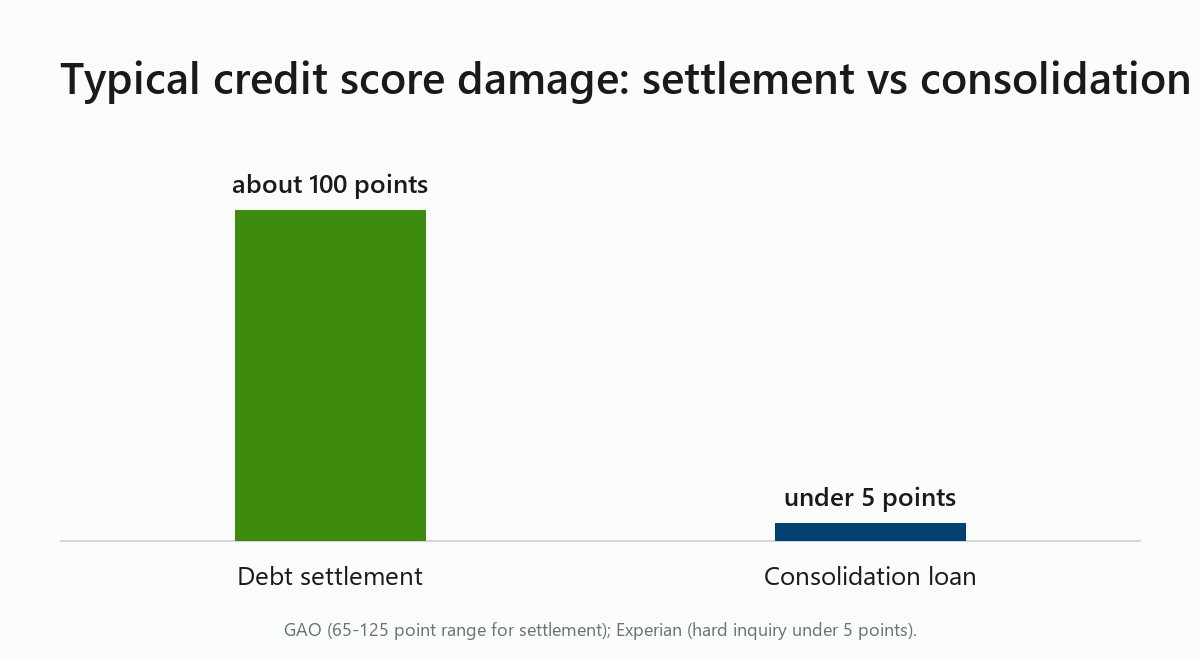
Debt settlement is rough on a score, and for a specific reason: payment history drives roughly 35% of a FICO score, and settlement requires you to stop making payments. Experian states that settling a debt is likely to lower a score by as much as 100 points or more, with people who started from a higher score generally seeing a steeper drop. The U.S. Government Accountability Office found a similarly harsh range in its review of the industry: FICO data showing that stopping payments as part of a settlement plan dropped scores anywhere from 65 to 125 points. That GAO report is from 2010, before the Federal Trade Commission's advance-fee reforms reshaped the industry, so treat its picture of company conduct as historical.
Its credit-score data holds up, though, because it's corroborated by Experian's current figures. And per that same Experian analysis, the missed payments behind a settlement stay on your credit report for 7 years from the date of the first missed payment.
Consolidation barely registers by comparison. Applying for a loan triggers one hard inquiry, and a hard inquiry typically costs fewer than 5 points, dropping out of FICO's scoring calculation entirely after 12 months. That same Experian analysis notes that moving revolving card balances into an installment loan can actually help your score over time: it improves your credit mix and, more importantly, drops your reported credit utilization, which makes up 30% of a FICO score, as long as you keep the paid-off cards open rather than closing them. If you want the dollar version of what those lost points actually cost on a loan, a full breakdown of what a 580 versus a 680 FICO score does to the price of a $15,000 loan makes the stakes concrete rather than abstract.
Put the two side by side and the gap is stark: settlement risks a 65 to 125 point hit, with the missed payments behind it on your report for 7 years, while consolidation risks a sub-5-point dip that's gone within a year.
The Real Cost: Fees, Interest, and the Tax Bill Nobody Mentions
Cost is where the settlement pitch gets the least honest, because the number in the ad (pay less than you owe) is only half the math.
Settlement companies typically charge 15% to 25% of your enrolled debt in fees, a range that's consistent across financial-journalism coverage of the industry rather than a figure set by any single regulator. Federal law does govern when that fee can be collected, though. Under the FTC's Telemarketing Sales Rule, a company selling debt relief by phone cannot collect any fee until it has actually settled one of your enrolled debts, you've approved that settlement in writing, and you've made at least one payment toward it. That rule exists because advance fees, charged before any work is done, used to be standard practice in this industry.
Then there's the part almost no ad mentions: the tax bill. When a creditor agrees to forgive part of what you owe, that forgiven amount doesn't just disappear. The IRS generally treats $600 or more in cancelled debt as taxable income, reported to you and the IRS on Form 1099-C.
If a creditor writes off $6,000 of your balance, that $6,000 typically gets added to your taxable income for the year, unless you qualify for an exclusion under that same IRS guidance. The two most common, among others, are a bankruptcy discharge under Title 11 and insolvency, meaning your liabilities exceeded your assets immediately before the debt was cancelled, claimed on Form 982. Forgiven debt counts as taxable income, not free money, the moment it's cancelled, a distinction that surprises plenty of people who go through settlement expecting a clean break.
Consolidation's cost structure is more straightforward, even if it sounds less exciting: you repay 100% of the original principal, plus whatever interest rate the new loan carries. There's no settlement discount and no 1099-C, because no debt was ever cancelled. The tradeoff you're making is a potentially lower rate in exchange for one payment, and the amount you owe stays fixed throughout.
Timeline: How Long Each Path Actually Runs
Settlement programs commonly run 24 to 48 months, according to both the GAO review and Experian's analysis, and that window isn't fixed because it depends entirely on how many creditors agree to negotiate and whether you keep the settlement account funded the whole time. Miss a contribution or have a creditor refuse to negotiate, and the timeline stretches. Meanwhile, the credit damage from the missed payments that got you into the program persists for up to 7 years, regardless of when the settlement process itself wraps up, per that same Experian analysis.

A consolidation loan restructuring that same balance typically pays off over roughly two to five years, depending on the amount and the rate you qualify for. There's no separate "industry standard" figure here, it's simply how installment loan terms tend to run, and unlike settlement, the payoff date is fixed the day you sign. Keep making payments on schedule and the loan ends on that date. There's no negotiation step that can stall it.
The Number the Ads Skip: How Many People Actually Finish
This is the statistic that debt-relief marketing never volunteers, and it matters more than the credit score hit or the fee schedule combined, because it changes whether the whole premise of "pay less than you owe" even applies to you.
The GAO's 2010 review found that federal and state agencies had documented completion rates under 10% for debt-settlement programs, even as the industry itself was claiming success rates of 34% to 60% at the time. That figure is old and predates the FTC's advance-fee reforms, so it shouldn't be read as a current snapshot of how these programs perform today. It should be read as the reason regulators started requiring the fee-timing rules they did.
More recent numbers, drawn from the debt-settlement industry's own trade group analysis of roughly 400,000 people enrolled in programs between 2011 and 2017, tell a gentler but still sobering story: 23% fully settled every debt they'd enrolled within 36 months, 43% settled at least 75% of their enrolled accounts in that window, and 74% managed to settle at least one account. Read the other direction, that means roughly three out of four enrollees did not fully complete their program within three years, according to the industry's own most favorable telling of its own results. A 2010 regulator review and an industry analysis of 2011 to 2017 enrollees land on the same core fact: most people who enroll in a debt-settlement program do not finish it as pitched.
That matters because every dollar of savings a settlement ad promises assumes you complete the program. If you drop out partway through, you're left with the credit damage from the missed payments, the fees already paid, and debts that were never actually settled.
The Risk Unique to Settlement: A Lawsuit While You're Still Saving
Consolidation carries no version of this lawsuit risk: the loan pays your creditors immediately, so no balance is ever left open for a creditor to sue over. Settlement is different, for the reasons covered in the CFPB warning above. The CFPB and multiple state attorneys general have brought repeated enforcement actions against debt-settlement companies over illegal fees and deceptive claims, which is a large part of why this industry draws the scrutiny it does.
Debt Consolidation vs Debt Settlement: Who Fits Each Path
Once the credit, cost, timeline, and completion numbers are on the table, the decision mostly makes itself for anyone willing to be honest about their own situation.
Debt settlement can make sense if you genuinely cannot repay the full principal on any realistic schedule. That's a narrow but real category: your income has been cut, a medical event wiped out your savings, or the math simply doesn't work no matter how the payment is restructured. If full repayment isn't achievable, a program built around paying less than you owe addresses the actual problem, even with the credit damage, the fees, and the tax bill that come with it. Before choosing it, weigh those costs against the completion odds honestly rather than against the number in the ad.
Debt consolidation fits a very different person: someone who can repay everything they owe, just not efficiently. If you're current on your payments but juggling five due dates and an average credit card rate that's eating your budget alive, consolidation solves the actual problem you have: one payment, a lower rate if your credit qualifies, and a fixed date when the debt is gone. It makes the same obligation easier to manage and, often, cheaper to carry, not smaller. If a bank turns you down for that loan, there are other ways to consolidate debt without a personal loan worth trying before settlement becomes the only option left.
If you're not sure which category you fall into, the credit-score math is a reasonable tiebreaker: settlement's damage runs to 100 points or more and lasts years, while consolidation's is minor and temporary. That asymmetry alone should push anyone who can repay in full toward consolidation. And whichever path you take, the rebuilding work afterward looks similar. A short list of specific credit-score moves you can make within 60 days is worth reading once your payment structure is settled, whichever direction you went.
Frequently Asked Questions
Is debt settlement the same thing as debt consolidation?
No. Debt settlement means you stop paying creditors while a company negotiates to pay less than you owe, damaging your credit in the process. Debt consolidation means a new loan pays off your existing balances in full, and you repay that same principal on one schedule, usually with less credit damage.
Does debt settlement hurt your credit more than debt consolidation?
Yes, substantially. Settlement can lower a score by 65 to 125 points or more and the damage can remain on your report for 7 years. Consolidation typically costs fewer than 5 points from a single hard inquiry, which drops off after 12 months.
Do you have to pay taxes on debt that gets settled?
Usually, yes. The IRS treats $600 or more in forgiven debt as taxable income reported on Form 1099-C, unless you qualify for an exclusion such as a bankruptcy discharge or proven insolvency claimed on Form 982. Those are the two most common exclusions, not the only ones the tax code allows.
Can a creditor sue you while you're enrolled in a debt settlement program?
Yes. The CFPB warns that creditors can file a debt-collection lawsuit at any point while you're not making payments, even if you're actively saving toward a settlement through an enrolled program. Enrolling in a program does not give you any legal protection from being sued.
How many people actually complete a debt settlement program?
Estimates vary by era and source. A 2010 GAO review found completion rates under 10%, while the settlement industry's own more recent analysis of roughly 400,000 enrollees found only 23% fully settled all their debts within 36 months.