


You've got a browser tab open with a lender's "check your rate" button staring back at you, and you're not totally sure what happens if you click it. Maybe you've carried credit card debt for years and never signed for a loan with a fixed end date before. That's a different animal than a credit card. If you're asking yourself how does a personal loan work before you commit to anything, you're doing exactly the right thing by asking first.
A personal loan is an installment loan: you borrow one lump sum, agree to a fixed rate and a fixed term, and pay it back in equal monthly installments until the balance hits zero. No revolving credit line, no minimum-payment trap. Here's the whole path, one step at a time, from the moment you check your rate to the day you make your last payment.
Step 1: Prequalification Starts With a Soft Look at Your Credit
Before you fill out a full application, lenders generally let you check your rate first. This step uses a soft credit pull, a type of credit check that does not affect your score at all. It's the lender's way of previewing what they'd likely offer you, a ballpark rate and term, without putting anything on your credit report that other lenders can see. This is the step designed for browsing, so use it: check a few lenders before you settle on one, since the rate and term you see here are estimates the lender can still adjust once it verifies your actual income and documents.
Once you move from checking your rate to actually submitting a full application, that becomes a hard pull, and hard pulls do show up and can shift your score a little. If you're comparing offers from a few lenders at this stage, the timing of those inquiries matters more than most people realize; Cashzella's guide, "Will Shopping for Personal Loan Rates Hurt Your Credit?" covers exactly how that works.
Step 2: The Full Application and What the Lender Checks
Submitting the full application means handing over more than your name and an income guess. Expect the lender to ask for proof of identity, proof of income (pay stubs, tax returns, or bank statements), and your Social Security number so it can run the hard credit pull. This is also where the underwriting system goes to work behind the scenes. Cashzella has already broken down exactly what happens in that window in "Inside the 90 Seconds After You Apply for a Loan".
Step 3: The Offer Lands, and the Real Numbers Show Up
If you're approved, you'll see an offer with a specific interest rate, an APR (a figure that folds in fees, so it usually runs higher than the plain interest rate), a loan term, and possibly an origination fee. According to Bankrate's July 15, 2026 rate survey, the average personal loan APR sits at 12.42%, based on a 700 FICO score, a $5,000 loan amount, and a three-year term. That average shifts depending on where you borrow: banks average 12.06% with a range of 6.74% to 25.99%, credit unions average 10.72% with a range of 6.09% to 18%, and online lenders span roughly 6.20% to 36%.
Some online lenders also charge an origination fee of up to 12% of the loan amount, deducted from the principal before the money ever reaches your account. Cashzella covers why that fee can make a lower-rate loan cost more overall in "Why a 9.99% Loan Can Cost More Than a 13% Loan". Before you sign anything, the lender has to disclose the APR, the finance charge, and the full payment schedule under the Truth in Lending Act; Cashzella walks through how to actually read that disclosure in "How to Read a Truth in Lending Disclosure on a Loan". And if you're trying to figure out whether the offer in front of you is actually worth taking, "Five Numbers That Decide if a Personal Loan Is Worth Taking" breaks down what to compare.
Step 4: Funding, or How Long Until You See the Money
Once you accept the offer, the clock starts on funding. According to Splash Financial's timeline for online personal loans, lenders typically fund a loan same-day to about five business days after final approval, and many disburse the money within one business day of that approval. Traditional banks tend to move slower, sometimes taking up to seven business days, per that same timeline. If you're borrowing to cover something with a deadline, a repair or a bill that's already due, that timeline gap is worth knowing before you pick a lender, not after. The money typically lands as a direct deposit into your checking account, and from that point forward, the loan behaves exactly like the agreement you signed: same payment, same due date, every month.

How Does a Personal Loan Work Month to Month? The Amortization Math
This is the part most explainers skip, and it's the part that actually shows where your money goes. Take that same example from Bankrate's rate survey: a $5,000 loan at 12.42% APR over 36 months. Your fixed monthly payment on that loan comes out to $167.08, and it stays the same for the life of the loan. What changes each month is how that $167.08 gets split between interest and principal.
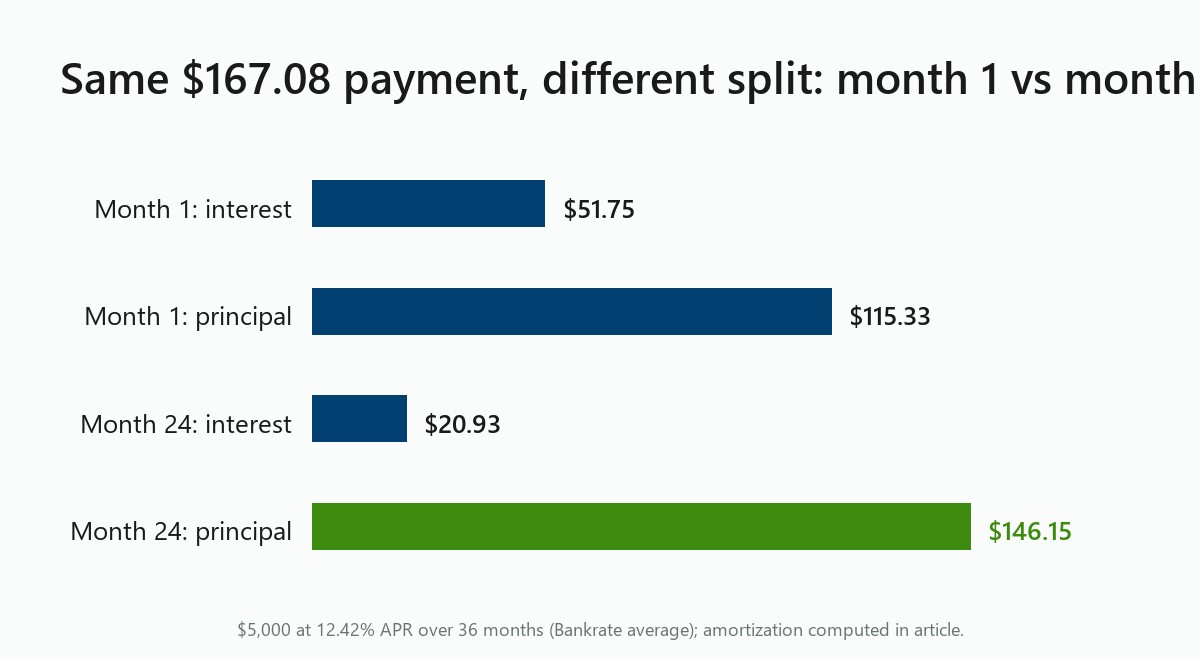
In month 1, you're paying mostly for the privilege of borrowing: $51.75 of that payment goes to interest, and $115.33 goes toward paying down what you actually owe. Fast forward to month 24, roughly two-thirds through the loan, and the split has flipped hard in your favor: $20.93 goes to interest and $146.15 goes to principal. That's the mechanic behind every fixed-rate installment loan. Interest is calculated on the balance you still owe, so as the balance shrinks, less of each payment gets eaten by interest and more of it chips away at the debt itself.
Hold this loan to the full 36-month term and you'll pay approximately $1,014.88 in total interest on top of the $5,000 you borrowed. That figure is the real cost of the loan, and it's exactly what the amortization schedule in your loan documents will show you, payment by payment, from month 1 to month 36.
Knowing this split matters for more than curiosity. If you're weighing a 36-month term against a longer one, a longer term lowers the monthly payment but stretches out the months where interest dominates the split, which is part of how a longer term ends up costing more in total interest even at a similar rate.
Autopay Discounts: A Small Detail Worth Setting Up
Autopay discounts are common enough that both SoFi and LightStream build them into their pricing. Enrolling means an automatic monthly deduction from your bank account instead of a manual payment each cycle. SoFi offers a 0.25% APR reduction for autopay enrollment, according to a Credible comparison of the two lenders, and that discount isn't required to get the loan in the first place. It can also stack with other discounts SoFi offers, like a separate member-rate reduction. Turn autopay off later and you lose the discount, and the loan re-amortizes at the higher rate.
LightStream takes the opposite framing: its advertised rates already assume you're enrolled in autopay, and skipping it pushes your rate up by roughly 0.50 percentage points, per that same Credible comparison. Across lenders, a discount somewhere between 0.25% and 0.50% is fairly typical. A quarter or half a point isn't going to make or break your monthly payment on a small loan, but over a few years it adds up to real savings for one checkbox during setup.
Making Payments on Time: The Part That Actually Builds Your Credit
Once the loan is funded, the day-to-day of it is simple: the same payment, on the same date, for as long as the term runs. That routine does more than keep the lender off your back. Payment history is the single largest factor in your FICO score, and Experian frames on-time personal loan payments as a direct contributor: every timely payment you make "adds to your positive payment history and helps promote credit score improvement".
The flip side carries real weight too. A payment that goes 30 or more days late "can do serious harm to your credit scores," according to Experian's reporting on personal loan credit impact. For a true first-time borrower, this is the step where the loan does its actual job: consistent, on-time payments are what turn an installment loan into one of the more reliable ways to build a track record lenders trust.
Paying Off a Personal Loan Early: How It Changes Your Interest Cost
Say your income jumps or a bonus lands and you want to knock the loan out ahead of schedule. Paying early reduces the total interest you owe, because interest accrues on your remaining balance. The sooner that balance hits zero, the less interest builds up between now and the original payoff date. Using the example above, paying off before month 36 means you never accrue the interest that would have piled up in the later months of the schedule.
Before you send extra money, check your loan agreement for a prepayment penalty, a fee some lenders charge for paying off a loan ahead of schedule. According to National Debt Relief, many personal loan lenders, especially online lenders, don't charge one at all, though how common these penalties are varies by lender. No single reliable industry-wide figure exists for how many loans carry one, so check your own contract before you assume either way. The Consumer Financial Protection Bureau's general guidance is straightforward here: read your contract, check your state's law, and ask your lender directly before you assume you're in the clear. Your Truth in Lending disclosure is the fastest place to look; if a prepayment penalty exists, it has to be spelled out there.
How a Personal Loan Affects Your Credit Score, Stage by Stage
Pulling this together into one sequence helps if you want to see the whole shape of it before you apply. Checking your rate uses a soft pull, so it costs you nothing on your score. Submitting the full application triggers a hard pull, and FICO and VantageScore treat multiple personal-loan inquiries made within a 14-to-45-day window as a single inquiry, which is exactly what makes rate shopping across a few lenders safe rather than risky.
That hard inquiry typically costs fewer than 5 points on a FICO Score, and the drag fades within a few months, according to Experian's July 30, 2026 credit-impact reporting. Opening the account can cause a second, separate small dip, this one from lowering the average age of your accounts, and Experian notes it's temporary as well.
From there, every on-time payment builds your payment history, the largest single factor in your FICO score. Carrying an installment loan alongside revolving credit, like a credit card, can also offer a small lift to your credit mix, a comparatively minor scoring factor according to FICO, but a real one. That initial dip is simply the cost of establishing the payment history that follows, so once your loan funds, the next move is the simple one: pay on time, every time, and let that track record do the work.
Frequently Asked Questions
How does a personal loan work compared to a credit card?
A personal loan gives you a lump sum upfront with a fixed interest rate, a fixed monthly payment, and an end date that's locked in the moment you sign, like the 36-month example above. A credit card is revolving debt with a variable rate and no fixed payoff date, which is why the two behave so differently over time.
How long does it take to get funded after applying for a personal loan?
Online lenders typically fund a loan same-day to about five business days after final approval, often within one business day of that approval. Traditional banks tend to move slower and can take up to seven business days from application to funds in your account, according to Splash Financial's funding timeline.
Does applying for a personal loan hurt your credit score?
Checking your rate uses a soft pull and does not affect your score at all. Submitting a full application triggers a hard pull, which typically costs fewer than 5 points on a FICO Score and fades within a few months, according to Experian.
What is an autopay discount on a personal loan?
It's a rate reduction, commonly somewhere between 0.25% and 0.50%, that lenders offer for enrolling in automatic monthly payments. SoFi offers a 0.25% reduction, and LightStream's advertised rates run about 0.50 points higher for borrowers who skip autopay, according to Credible's lender comparison.
Does paying off a personal loan early actually save you money?
Yes, generally. Interest accrues on your remaining balance, so paying it off sooner means less interest accumulates between now and the original payoff date. Just check your loan agreement first; many lenders, especially online ones, charge no prepayment penalty at all, but it varies by lender, so confirm before you send extra money, per National Debt Relief.
Why does more of my payment go to principal later in the loan term?
Interest is calculated on your remaining balance, not the original loan amount you borrowed. As you pay down that balance, each payment owes less in interest and more of it shifts to principal, which is why a month-24 payment on a loan looks so different from that same loan's month-1 payment.
What documents do lenders usually ask for during the full application?
Expect requests for proof of identity, proof of income such as pay stubs or bank statements, and your Social Security number so the lender can run its hard credit pull. Having these ready before you apply is one of the simplest ways to keep the underwriting step moving without back-and-forth delays.