

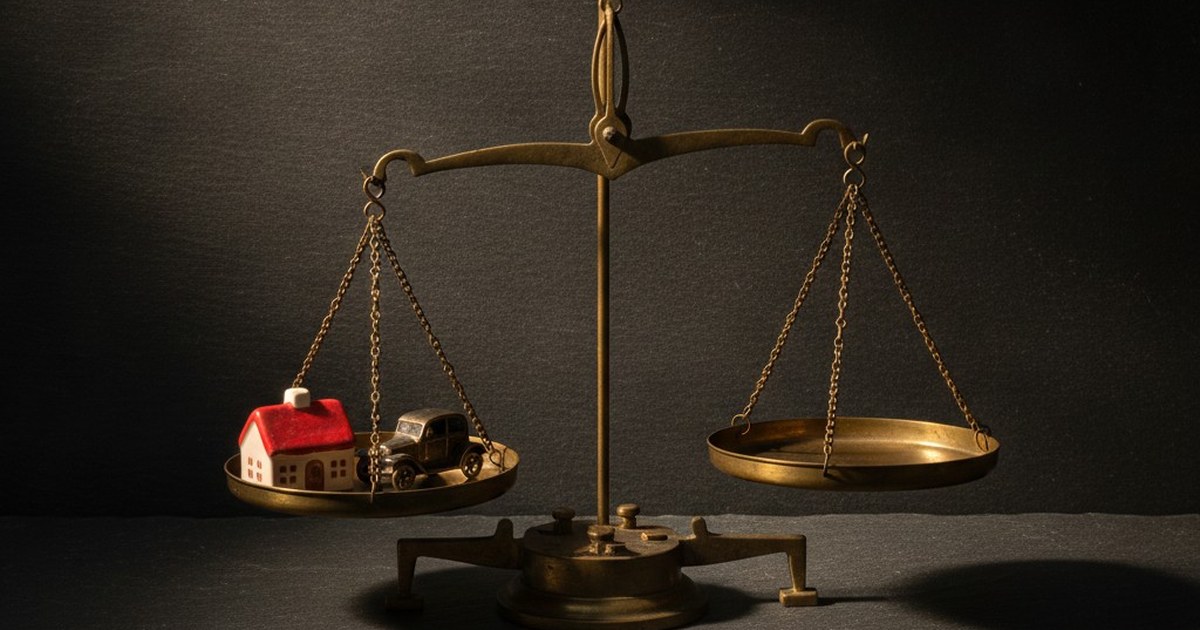
You're comparing two loan offers, and one word keeps showing up on both: "unsecured." One lender wants your car title as backup. The other just wants your credit report, your pay stubs, and a signature. Same $10,000, two completely different applications, and neither page explains why. If that's the question that sent you looking up what an unsecured personal loan actually is, here's the answer nobody puts on the borrower-facing page: when there's no asset for the lender to fall back on, your interest rate has to carry the entire risk of the loan by itself. Credit score, income, debt-to-income ratio, all of it exists because that risk has to land somewhere.
What "Unsecured" Actually Means
The Consumer Financial Protection Bureau draws the line simply: a secured loan is backed by collateral the lender can seize if you stop paying, while an unsecured loan carries no collateral at all, and the lender instead relies on your promise to repay, backed by your credit history. That promise is the entire security. Not a house. Not a car. Not a savings account sitting in reserve somewhere. Just your track record and the paperwork you signed.
Experian, one of the three major credit bureaus, describes unsecured personal loans as products where approval rests on your credit score, income, and existing debt, since there's no asset backing the loan for the lender to fall back on if you default. That's also why default looks different on an unsecured loan than it does on a secured one. There's no truck for the lender to tow. Instead, a missed unsecured loan payment turns into negative marks on your credit report, collection calls, and in some cases a lawsuit that ends in a judgment against you. It's a real consequence. It's just not the same consequence as losing an asset you can see and touch.
Unsecured personal loan balances aren't a small corner of the lending market, either. They reached $207.1 billion across U.S. credit reports in 2025, up 7.4% from the year before, according to Experian's own aggregated credit data. More than 30 million unsecured personal loan accounts exist nationally (same source). That growth has come with rising risk attached: the share of unsecured personal loan accounts 30 or more days past due has hovered around 4% since 2024, a figure Experian tracks from its own credit-report data rather than an independently audited study (same source). Rising balances alongside rising delinquency are exactly the backdrop that pushes a lender to price risk carefully when there's no collateral sitting behind the loan.
What Replaces Collateral in Underwriting
Take the collateral away, and a lender still needs some way to estimate whether you'll pay the loan back. Three inputs do that job: your credit score, your income, and your debt-to-income ratio.
Credit score
Your credit score is the quickest evidence a lender has of how you've handled debt before this application. Borrowers with a credit score of 690 or higher generally have the best odds of getting approved for an unsecured personal loan, according to NerdWallet's comparison of secured and unsecured lending. Below that range, approval gets harder, and the rate for anyone who does qualify climbs to compensate. That trade is already visible in real market rates: Bankrate's average personal loan rate sits at 12.42% APR for a 700 FICO borrower on a $5,000 loan with a three-year term, updated August 12, 2026, while the lowest advertised rates for excellent-credit borrowers run around 6.20% and subprime borrowers can see rates near 36%. That gap runs about 30 percentage points, with credit tier driving most of that spread, and it's worth knowing exactly how much a low credit score adds to your rate before you assume the number on your screen is fixed. Comparing your rate at a few lenders before you commit costs you nothing but time, and knowing how rate-shopping affects your credit score first means those extra checks won't feel like a gamble.
Income
Income tells a lender whether you have the cash flow to support a new payment on top of what you already owe. Underwriters look past a single paycheck, too. Experian notes that lenders consider gig work, investment income, and alimony alongside traditional wages when they evaluate an application, since a fuller income picture reduces the guesswork around whether a new payment actually fits your budget. Without collateral to fall back on, a lender wants documented proof of dependable income, not an estimate on an application form.
Debt-to-income ratio
The third piece is debt-to-income ratio, or DTI: your monthly debt payments measured against your monthly income. Add up what you already owe each month, divide by what you bring home, and that percentage tells a lender how much room is left in your budget before a new payment becomes a strain. There's no single federal percentage that applies here. You may have run across a debt-to-income threshold from mortgage underwriting, but that concept doesn't carry over to personal loans as a legal ceiling. Personal loan lenders set their own DTI cutoffs instead, and those cutoffs vary from one lender to the next. What stays consistent is the logic: the lower your DTI, the more convinced a lender is that you can absorb one more payment without a collateral safety net behind the loan. Once you actually submit an application, this credit-score-income-DTI evaluation kicks off a specific sequence worth understanding on its own, covering what happens in underwriting after you apply.
A $10,000 Loan, Two Ways: Secured vs Unsecured by the Numbers
Numbers make this easier to see than any definition. Picture two versions of the same $10,000 loan, both over a three-year term.
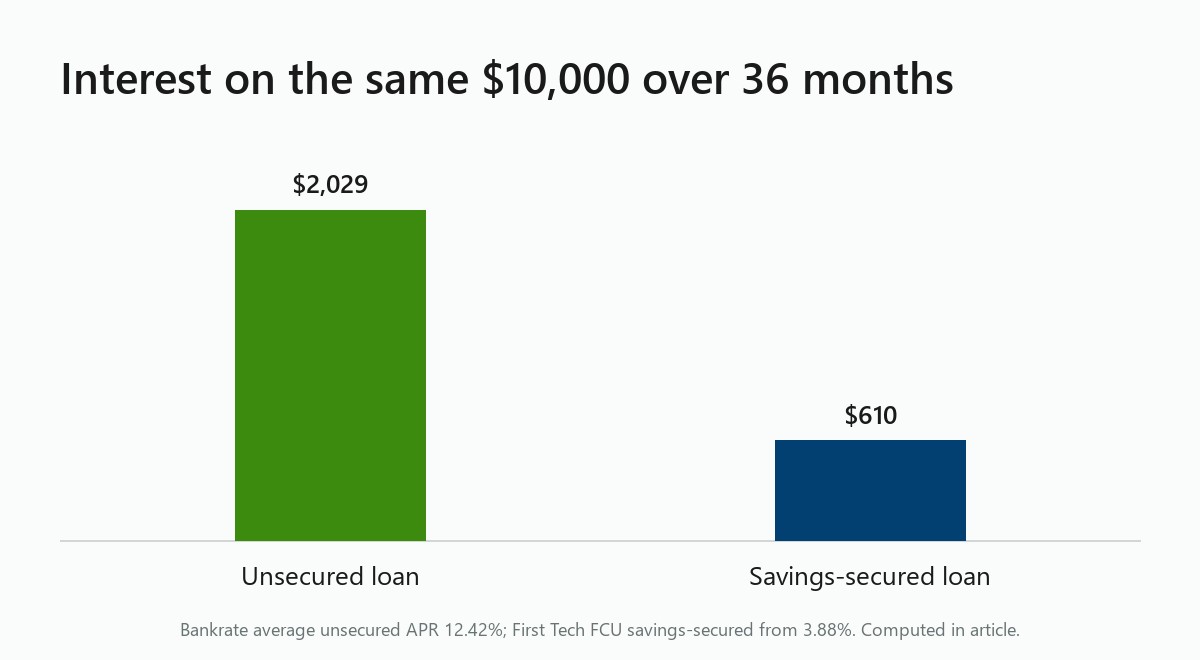
The unsecured version: at Bankrate's average unsecured personal loan rate of 12.42% APR, a $10,000 loan over 36 months carries a monthly payment of about $334. Run that payment out across three years and you'd repay roughly $12,029 total, meaning about $2,029 goes to interest. No asset backs this loan. If you stop paying, the lender can't repossess anything, but it can report the missed payments to the credit bureaus, send the account to collections, and eventually sue for the balance.
The secured version: First Tech Federal Credit Union prices its savings-secured loan, where you pledge money already sitting in your own savings account, at the member's savings rate plus as low as 3.00%, producing an illustrative APR as low as 3.88%. At that rate, the same $10,000 over 36 months carries a monthly payment of about $295, and you'd repay roughly $10,610 total, or about $610 in interest. If you stop paying this one, the credit union can simply take the savings you pledged. No lawsuit needed. The collateral is already sitting in the lender's hands.
Line those two examples up and the spread is stark: roughly $1,419 in interest separates an unsecured $10,000 loan from a savings-secured one over the same three years. That spread reflects the entire premise of secured lending: pledge something real, and the lender's risk drops enough to pass real savings back to you.
Two other credit union numbers back this up without even leaving the credit union world. 1st United Credit Union lists unsecured personal loan APRs from 8.39% to 20.29%, a range that sits well above what a saver could get by pledging their own savings account at a place like First Tech. Same kind of institution, same borrower, two different products, two different price tags for the identical dollar amount, and that's before you even get into why two lenders quote different rates for the same borrower on the exact same loan type.
Approval odds move in the same direction as the rate. NerdWallet notes that adding collateral generally improves your approval odds, particularly if your credit sits below that 690 mark, because collateral shifts the lender's risk off your credit profile and onto the asset you pledged. There isn't a reliable published percentage for exactly how much easier approval gets. What's consistent across sources is the direction: less risk on the lender's side means a better shot at approval on yours.
When Pledging Collateral Is the Smarter Move
If your credit sits below 690, let the math above change how you think about your options instead of leaving you feeling bad about your score. A lower unsecured rate isn't available to you the way it is to a 700-plus borrower, and Bankrate's own subprime figures show why: rates for borrowers with damaged credit can run as high as 36% APR on an unsecured loan. At that rate, a $10,000 loan over three years costs about $458 a month and roughly $6,490 in interest total, more than ten times what the savings-secured example above would cost.

For a borrower in that position, collateral does two things a better credit score can't do overnight: it drops the rate meaningfully, and it improves approval odds without waiting months or years to rebuild credit. If you have a paid-off car, an emergency fund sitting in savings, or another asset you're genuinely willing to put on the line, a secured loan can be the more affordable choice, even though the word "collateral" feels riskier on its face than the word "unsecured."
There's a pattern worth naming honestly here, too, one you'll recognize if you've ever compared notes with a friend or family member shopping for the same kind of loan. People often feel relief that an unsecured loan doesn't put a car or a savings account on the line, then real frustration when their rate comes back much higher than a relative's secured loan quote for a similar amount. That frustration is data of a kind. It's usually the market telling you that collateral would have priced this loan differently.
What You Give Up by Securing the Loan
None of this makes collateral free of downside. Two trade-offs are worth naming before you pledge anything.
First, the asset you pledge is genuinely at risk. A savings-secured loan uses money you already have, so if you default, the credit union simply takes it. There's no lawsuit or collection process required, which is faster for the lender but also means there's no extra step where you might negotiate your way out. A vehicle-secured loan works the same way with your car: miss enough payments and the lender can repossess it, and state law governs how fast that can happen and what happens to any remaining balance after the sale.
Second, funding can take longer. An unsecured loan approval often turns on checks a lender can run electronically: a credit pull, income verification, a DTI calculation. A secured loan adds a step, since the lender has to confirm the value of the collateral itself, whether that means verifying a savings balance or appraising a vehicle, before the loan can fund. Most borrowers won't find that timeline a dealbreaker, though if you need cash within a day or two, ask your lender directly how long collateral verification adds to it.
Whichever way you lean, rate is only one of the five numbers to compare before accepting an offer, and the collateral decision changes more than just that one figure. Read the full terms before you sign either kind of loan. The cheaper monthly payment on paper isn't worth much if you didn't go in understanding what you'd actually be putting up to get it.
Frequently Asked Questions
Is a personal loan usually secured or unsecured?
Both types exist, and they work very differently. Experian describes unsecured personal loans as approved based on your credit score, income, and existing debt rather than collateral, with online-lender APRs on this loan type spanning 5.96% to 35.99%. Secured personal loans exist too, usually backed by savings or a vehicle, and they tend to carry lower rates since the lender has an asset to fall back on.
What credit score do you need for an unsecured personal loan?
There's no single universal minimum, but NerdWallet notes borrowers with a credit score of 690 or higher generally have the best odds of approval. Below that range, approval gets harder, and rates for anyone who does qualify tend to run much higher because the lender is pricing in more risk.
Can you lose your house or car with an unsecured personal loan?
Not through repossession. An unsecured personal loan has no collateral attached, so there's nothing tied to the loan for a lender to repossess if you stop paying. Defaulting still carries real consequences, including damaged credit, collection activity, and potentially a lawsuit, but not the loss of a specific pledged asset.
Why do unsecured personal loans have higher interest rates than secured loans?
Because there's no asset backing the loan, the lender's entire protection against default is the interest rate itself. Bankrate's average unsecured rate runs 12.42% APR, while First Tech Federal Credit Union's savings-secured loan can run as low as 3.88% APR, since pledged collateral shifts risk off the rate and onto the asset.
Is it easier to get approved for a secured or unsecured personal loan?
NerdWallet notes that secured loans generally offer better approval odds, especially for borrowers below a 690 credit score, because pledging collateral shifts risk off your credit profile and onto the asset. The direction holds even without a precise number: less risk for the lender generally means a better shot at approval for you.