


You checked your score and it's sitting somewhere in the 400s, maybe worse. Your stomach dropped. Before you spiral, let's answer the actual question on your mind: what is the lowest credit score a person can carry, and how close are you standing to it?
I spent years underwriting loan files for a living, reading credit reports the way a mechanic reads an engine that won't turn over. I've seen where the real floor sits, and I've seen how rarely anyone actually lands there. What I never saw was a borrower drop into that basement from one missed payment.
That takes a pile-up of trouble, built up over time. A single slip won't sink you that far. That basement is a lot less crowded than the panic in your chest is telling you right now, and understanding why matters more, at this moment, than beating yourself up over the number on the screen.
The Real Floor: Why 300 Is the Lowest Possible Credit Score
The number itself is simple. Both major scoring systems bottom out at 300. The FICO score floor is 300 for the base scores (versions 8, 9, and 10) that most lenders pull when you apply for a credit card, auto loan, or mortgage (myFICO). A handful of industry-specific FICO scores, built for auto lenders or bankcard issuers, run on a wider 250 to 900 scale, but those aren't the number your bank shows you on its app.
VantageScore, the model built jointly by the three credit bureaus, uses that same 300 to 850 range across its 3.0, 4.0, 4plus, and 5.0 versions. VantageScore was the first tri-bureau score to adopt the 300 to 850 range, back in 2013, and it has kept it ever since (VantageScore).
So the lowest possible credit score, on paper, is 300. In practice, almost no one is sitting on that exact number. Scoring models need a real volume of negative activity reporting before they'll drag a file all the way to the bottom, and most cases that look catastrophic still land somewhere in the 400s rather than at the literal floor, an inference drawn from the distribution data below rather than a statistic FICO or VantageScore states directly.
That gap between what's technically possible and what actually shows up on real credit reports tells you something useful about your own file. If you're reading this at 420 or 460, you're already deep in rare territory, but you're not standing on the exact edge most people picture when they hear the number 300.
Think of the scale like a stack of paperwork on a loan officer's desk. A score sitting exactly at 300 would mean every account on your report reported the worst possible outcome, at the worst possible severity, with nothing offsetting it anywhere. That's an extreme combination to hit in practice, because most people carry at least one account that's still in decent standing, or an older negative mark that's already aged partway out of its weight in the model.
How Rare Is a Sub-500 Credit Score, Really
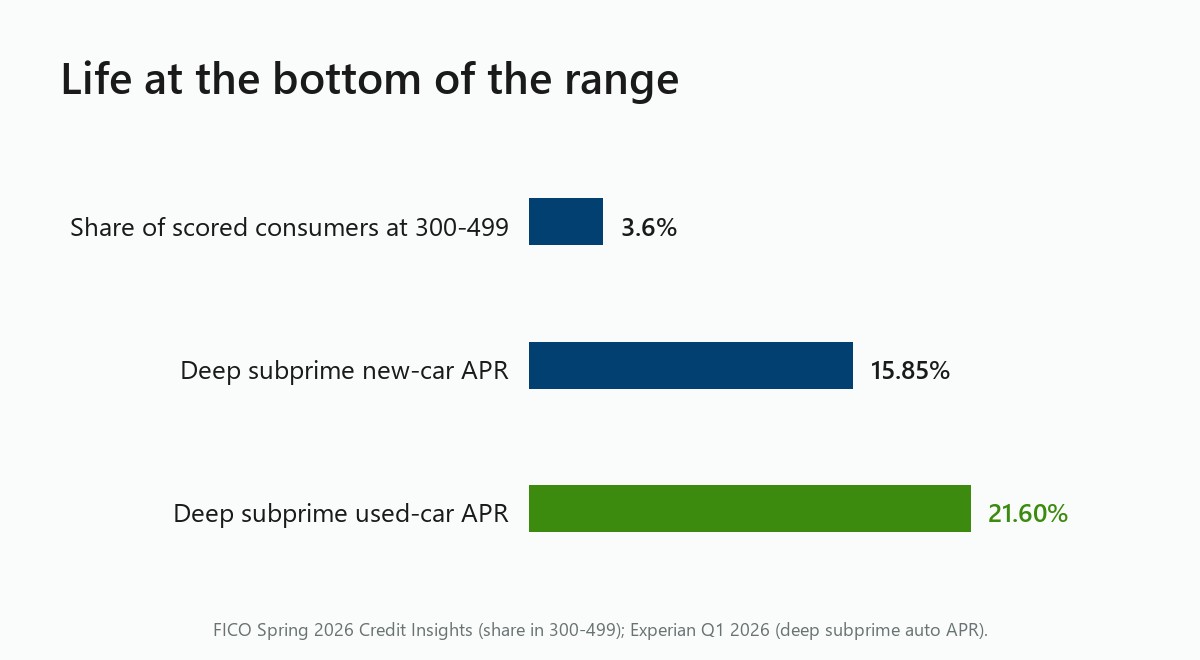
Here's the part that surprised me when I first saw it. FICO's own Spring 2026 Credit Insights report found that only about 3.6 percent of scoreable U.S. consumers fell into the 300 to 499 band, up from 3.2 percent a year earlier (FICO Score Credit Insights, Spring 2026 Edition). The same report put the national average FICO score at 714, down slightly from 717 the year before.
Read those two numbers together and you get a market splitting apart at both ends. The same FICO Spring 2026 report also shows a record share scoring 750 and above, even as that bottom band grew year over year. You're not imagining that things feel more polarized out there.
But look at what that 3.6 percent actually tells you: a sub-500 credit score puts you in a small minority, and small minorities don't get there by accident. Nobody drops into the bottom 3.6 percent of American credit files over one late car payment. It takes months of things going wrong at once, and that's worth sitting with, because the path back up starts with identifying exactly what stacked up. Agonizing over a single mistake won't get you there.
I want to be straight with you about why that distinction matters. Borrowers who treat a low score as a moral verdict tend to freeze. They stop opening their mail from creditors, stop checking their own reports, and let the file rot further while they avoid looking at it.
Borrowers who treat it as a mechanical outcome, a specific set of accounts reporting a specific set of problems, tend to move faster, because a mechanical problem has mechanical fixes. You are in a small band of the population right now, and that band got there through documented events on a report. It has nothing to do with character. Keep that distinction in your head for the rest of this article.
What Causes a 400 Credit Score (and Lower)
I underwrote thousands of applications, and I can tell you the myth that needs killing first: one late payment does not put a file anywhere near the 400s. A single 30-day late mark hurts, sure. It doesn't gut a score on its own.
What actually produces a file in the 300 to 499 band is several derogatory marks landing and staying at the same time: multiple missed or late payments spread across different accounts, one or more accounts sent to collections, a bankruptcy filing, a defaulted loan, a repossession or foreclosure, and revolving balances maxed out or close to it. Typically it's several of those landing together. That damage builds over months, and a single bad week doesn't cause it (Experian).
FICO's own delinquency-odds table backs this up from a different angle. Consumers scoring 579 or below have a 59 percent chance of becoming seriously delinquent, 90 days or more past due, within the next 24 months. Compare that to 27 percent for the 580 to 669 band, 8 percent for 670 to 739, 2 percent for 740 to 799, and just 1 percent for scores above 800 (myFICO). That table exists for a reason: a score that low is a genuine prediction of future risk, and the industry built an entire scoring band around it.
A repossession is a good example of how the pile-up actually works, because it's rarely an isolated event. By the time a lender actually tows the car, the borrower has already taken the hit from the 60-day late mark, then the 90-day mark, then the 120-day mark, each one reported and each one dragging the score down before the vehicle is ever repossessed. Then the lender sells the car for less than what was owed, and the leftover deficiency balance often gets sent to a collection agency, which hits the file again. Each link in that chain reports separately, on its own timeline (mechanism described by Nasdaq).
One borrower's story, published through an AOL feature drawn from a Reddit post, captures the shape of it well, though it's a single account and not a statistic. She described dropping from a 780 to a 417 during a stretch that included addiction and job loss, accumulating seven separate collections from unpaid credit cards, bank bills, and medical bills, and losing her vehicle in the process. She eventually rebuilt to 555 after repaying roughly $20,000 and getting most of those collections removed from her file (AOL). That's the pattern that shows up again and again in real files: derogatory marks stack from several directions at once until the score reflects the whole pile.
What a Score This Low Costs You Right Now
A low score changes what you're offered and what you're charged, starting immediately.
Auto lending is the clearest example, because it's priced in real time. Deep subprime borrowers are paying average APRs of 15.85 percent on new-vehicle loans and 21.60 percent on used-vehicle loans, in Experian's "Adapting to Change: Subprime Borrowers Re-entered the Market" report. Run that math on a typical loan and a deep subprime borrower pays thousands more over the life of it than someone with a clean file, for the same car. I broke down what 100 FICO points really cost on a $15,000 personal loan in a separate piece on this site.
Unsecured credit cards are mostly off the table at this range. Most sub-500 applicants won't be approved for standard revolving credit at all, so the realistic product is a secured card: you put down a refundable deposit that becomes your credit limit, pay an annual fee, and use the card to rebuild. The real cost shows up in the deposit you have to come up with and the fee you carry while you climb back out.
Housing gets harder too, though the specifics vary by state and by landlord. A property manager may ask for the maximum deposit your state allows, and don't be surprised if they also want a co-signer or extra months of rent paid upfront before handing you keys. Utility providers commonly run a soft credit check as well, and if your file is rough, they may ask for a deposit or a letter of credit before turning on service in your name.
These companies aren't punishing you personally. They're pricing for a risk they can't otherwise measure.
Straight loan denials get more likely too, and if you're turned down, you have real rights around that decision that most people never use. I wrote a full breakdown of your legal rights after a personal loan denial letter, covering what an adverse action notice has to disclose and how to use it.
The First Three Moves Off the Floor
Underwriters don't care about your excuses. They care about your file. The first three moves target the file itself.

Fix what's on the paper first, and the number takes care of itself later. That order matters, because chasing the score directly, without touching what's actually reported, wastes your effort.
- Pull every report and confirm what's actually reporting. Get your reports from all three bureaus and go through each derogatory item line by line. Confirm the balances are right, confirm the accounts are actually yours, and confirm each item is still eligible to be reporting. Wrong balances, mismatched accounts, and stale items show up on real files more often than most borrowers expect, and every inaccurate item you get corrected or removed is points back in your pocket for free.
- Stop the bleeding on anything still open. If you have accounts that are still delinquent but not yet charged off, bring them current if you can, or work out a resolution with the creditor if you can't. A file that's still collecting new damage every month can't start recovering, no matter what else you do.
- Start reporting positive activity through a secured tool. A secured credit card or a credit-builder loan reports on-time payments to the bureaus the same way any other account does. It builds a new pattern that scoring models can see over time, and that new pattern is what eventually pulls the number back up.
None of that runs on a fixed schedule. It takes sustained months of on-time payments and reporting activity to show up in a score. Weeks won't do it, so don't expect a dramatic jump after one payment cycle. If you want the tactical, step-by-step version of how to work these three moves in a compressed window, I laid out three proven moves to raise your credit score in 60 days in another article on this site.
Frequently Asked Questions
Can your credit score actually be 300?
Yes. myFICO and VantageScore both put the floor at 300, but it's rare in practice. Reaching the literal bottom requires an extreme volume of negative reporting. Most files that look catastrophic still land somewhere in the 400s rather than at exactly 300, since real files rarely hit every worst-case mark at once.
How rare is a 300 credit score, or anything close to it?
Genuinely rare. FICO's Spring 2026 Credit Insights report found only about 3.6 percent of scoreable U.S. consumers fell into the 300 to 499 band, up from 3.2 percent the year before. If your score lands in that band, you're in rare territory. It usually means several serious problems piled up on the report together.
What causes a 400 credit score?
A 400 credit score comes from several serious problems reporting at the same time: accounts in collections, a bankruptcy, a defaulted or repossessed loan, and revolving balances maxed out. These problems typically build over months as multiple accounts start reporting trouble together (Experian).
How long does it take to climb out of the 400s?
There's no fixed number of months that applies to every file, and quoting one would be a guess dressed up as a fact. It takes sustained, on-time payment activity reporting over months before a scoring model reflects meaningful recovery. Weeks won't move the needle.
Will lenders approve you with a score this low?
Standard unsecured products are unlikely to approve you at this range, and you should expect denials on typical credit cards and many personal loans. Secured products, like secured credit cards and credit-builder loans, are usually the realistic path back in. If you are denied, the Equal Credit Opportunity Act requires the lender to tell you why in a written adverse action notice.